Alexander Nikolayevich Scriabin
| Alexander Nikolayevich | Scriabin • Skriabin • Алекса́ндр Никола́евич Скря́би |

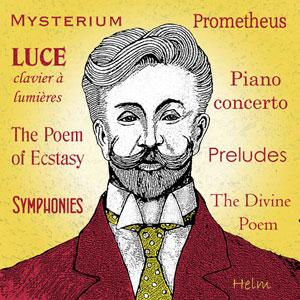
Warning: images may be copyrighted. If no copyright is shown, see their site of origin for details, or contact me.
Composition list
Symphonic music
Chamber music
Instrumental music
Opera and lyrical music
Vocal music
Concertante music
Compositions sorted on opus (if available)
74 numéros
inachevé
Op. 1
Op. 2
Op. 3
Op. 4
Op. 5
Op. 6
Op. 7
Op. 8
Op. 9
Op. 10
Op. 11
Op. 12
Op. 13
Op. 14
Op. 15
Op. 16
Op. 17
Op. 18
Op. 19
Op. 20
Op. 21
Op. 22
Op. 23
Op. 24
Op. 25
Op. 26
Op. 27
Op. 28
Op. 29
Op. 30
Op. 31
Op. 32
Op. 33
Op. 34
Op. 35
Op. 36
Op. 37
Op. 38
Op. 39
Op. 40
Op. 41
Op. 42
Op. 43
Op. 44
Op. 45
Op. 46
Op. 47
Op. 48
Op. 49
Op. 51
Op. 52
Op. 53
Op. 54
Op. 56
Op. 57
Op. 58
Op. 59
Op. 60
Op. 61
Op. 62
Op. 63
Op. 64
Op. 65
Op. 66
Op. 67
Op. 68
Op. 69
Op. 70
Op. 71
Op. 72
Op. 73
Op. 74
s.opus
Sheet music for Alexander Nikolayevich Scriabin

Prelude et nocturne pour piano pour la main gauche seule : op.9 — Aleksandr Nikolayevich Scriabin
piano — —
Composed by Aleksandr Nikolayevich Scriabin and Aleksandr Nikolayevich Scriabin. This edition: pamphlet. Published by Library Commerce (LC.39087012841039).
Price: $6.00

Sonate no. 10 pour piano, op. 70 — Aleksandr Nikolayevich Scriabin
piano — —
Composed by Aleksandr Nikolayevich Scriabin and Aleksandr Nikolayevich Scriabin. This edition: pamphlet. Published by Library Commerce (LC.39087012660058NO10).
Price: $7.00

Sonate no. 4, Fa#, pour piano, op. 30 — Aleksandr Nikolayevich Scriabin
piano — —
Composed by Aleksandr Nikolayevich Scriabin and Aleksandr Nikolayevich Scriabin. This edition: pamphlet. Published by Library Commerce (LC.39087012659969).
Price: $6.00

Sonate no. 8 pour piano, op. 66 — Aleksandr Nikolayevich Scriabin
piano — —
Composed by Aleksandr Nikolayevich Scriabin and Aleksandr Nikolayevich Scriabin. This edition: pamphlet. Published by Library Commerce (LC.39087012660058NO8).
Price: $9.00

Sonate no. 9 pour piano — Aleksandr Nikolayevich Scriabin
piano — —
Composed by Aleksandr Nikolayevich Scriabin and Aleksandr Nikolayevich Scriabin. This edition: pamphlet. Published by Library Commerce (LC.39087012660058NO9).
Price: $7.00

Sonate-fantaisie No. 2, en sol-diese mineur, pour piano, op. 19 — Aleksandr Nikolayevich Scriabin
piano — —
Composed by Aleksandr Nikolayevich Scriabin and Aleksandr Nikolayevich Scriabin. This edition: pamphlet. Published by Library Commerce (LC.39087012659928).
Price: $7.00

6 preludes pour piano, op. 13 — Aleksandr Nikolayevich Scriabin
piano — —
Composed by Aleksandr Nikolayevich Scriabin. This edition: pamphlet. Published by Library Commerce (LC.39087022428405).
Price: $7.00

Sonata no. 6, op 62 — Aleksandr Nikolayevich Scriabin
piano — —
Composed by Aleksandr Nikolayevich Scriabin. This edition: pamphlet. Published by Library Commerce (LC.39087012660033).
Price: $7.00

Alexander Scriabin: the Compos — Alexander Scriabin
— listening CD —
By Alexander Scriabin. By Alexander Scriabin (1872-1915). Listening CD. Published by Naxos (NX.PIR0018).
Price: $18.00

Scriabin - Complete Preludes And Etudes Piano — Alexander Scriabin
Piano — Softcover Book —
For Solo Piano. Composed by Alexander Scriabin (1872-1915). Piano Solo, Piano & Keyboard, Repertoire, Collections. Scriabin - The Complete Preludes and Etudes. Softcover Book. 250 pages. Dover Publications #9780486229195. Published by Dover Publications (HU.9780486229195).
Price: $23.00
Orchestral music
- Piano Concerto, Opus 20
- Reveries, Opus 24
- Symphony No. 1, Opus 26
- Symphony No. 2, Opus 29
- Symphony No. 3, Opus 43 (Divine Poem)
- Symphony No. 4, Opus 54 (Poem of Ecstasy)
- Symphony No. 4, Opus 54 (arranged 2 Pianos)
- Symphony No. 5, Opus 60 (Prometheus, Poem of Fire)
- Fantasy for Piano and Orchestra
- Mysterium - (Prefatory Act)
- Symphonic Poem D Minor
Alexander Scriabin (Aleksandr Skriabin) was born 25 December 1871
in Moscow. His mother died when he was two, and he was then raised by a
grandmother and his Aunt Liubov. He began formal study of the piano at 12
with Georgy Conus. In 1884–85 he studied piano with Nikolai Zverev, at whose
house a small group of piano pupils boarded, including 11-year-old
Sergei Rachmaninoff.
He entered the Moscow Conservatory at 17, studying piano with Vasily Sofonov.
He learned theory with Sergei Taneyev, and was in Anton Arensky’s composition
class where classmate and friend Rachmaninoff was Arensky’s star pupil. Ironically, Arensky once threatened to flunk Scriabin who was musically somewhat too adventurous for his teacher.
In 1892, Scriabin sought to graduate a year early like Rachmaninoff but
was refused by Arensky, whereupon, enraged, Scriabin quit and set out
on a career as a concert pianist and recitalist. In 1897 he married pianist Vera Ivanovna Isakovich, The following year, Moscow Conservatory piano professor Paul Schloezer died, and Scriabin took his place. By 1902, the Scriabins had three daughters (Rimma, Elena, and Maria) and one son (Lev).
During this time, he became interested in Goethe and Nietzsche. Then, in 1903,
he left his post at the Moscow Conservatory. At the same time, he began
an extramarital love affair with Schloezer’s niece, the seductively attractive Tatyana Fyodorovna.
The first significant phase of his artistic career (1891–1902, comprising opus nos. 4–28)
is marked by sets of piano works in smaller forms
(preludes, mazurkas, études, etc.), modelled on the styles of Chopin
and Liszt. In these works, however, Scriabin goes beyond his models,
bringing an extra richness, delicacy, and clarity to the idiom of
his early romantic predecessors.
The enthusiasm and intensity in some of Scriabin’s mazurkas, for example,
make them seem at times more brilliantly “Chopinesque” than Chopin
himself! The Second and Third Sonatas give further witness to the fresh vitality
Scriabin will bring to this form.
In the early years of the century, Scriabin devoted much of his effort to
symphonic writing, and it was through this that he first achieved a major
metamophosis in personal idiom, strongly coloured with Wagerian harmony.
Scriabin produced his first and second symphonies, and his Divine Poem,
or Third Symphony, during this time. His robust and passionate Fourth Piano
Sonata is a good example of this transitional period, especially in contrast
with both the Third and Fifth sonatas.
From 1904 to 1908, Scriabin lived abroad. In 1904 he went to
a philosophy conference in Geneva, and heard
href="/comp/wagner">Wagner’s
Die Walküre in Paris. In 1906 a daughter Ariadna was
born — his first child by Tatiana. During the 1906-07 season, he made his
American debut with his own Piano Concerto, but his tour was abruptly
curtailed when its sponsors feared public impact were it discovered that
he was still married to
a woman other than the one he was with. In Brussels, he frequented
theosophical circles, both satisfying and feeding his impulse for spiritual
and philosophical realms. At this time, he composed both
his striking Fifth Sonata and his orchestral Poem of Ecstasy,
Op. 54.
His compositions, whose harmonic
language was now marked by a more elaborate chromaticism, were
increasingly given titles of a symbolist bent (eg., Poème ailé, Poème languide).
In 1908, a second child, a son, Julian, was born to Scriabin and Tatiana Fyodorovna.
With the completion of his last symphonic work (The Poem of Fire:
Prometheus), Scriabin completely broke through all tonal constraints
and devised a harmonic style based on superimposition of diminished and
augmented fourths — though it is also much more than this. [Note: All this
is best understood through direct listening than through any amount of technical descriptive terminology.]
The five last years of his life were devoted solely to the piano.
These compositions include
Sonatas 6 through 10, sets of smaller-scale pieces, and especially
Vers la Flamme.
His seventh and last child, Marina, was born, and his father and his son,
Lev, also died.
At the same time, he was an active performing artist.
With Serge Koussevitzky and the Imperial Bolshoi Orchestra, he
went as piano soloist on a Volga steamboat tour. He also
made numerous acclaimed appearances as a solo recitalist in Moscow,
St. Petersburg, and London.
In this final period, Scriabin abandons even
the need for any form of rhythmic beat, instead superimposing different
time-values, through a layering of harmonic and thematic material, and
making use of acoustic effects like trills and tremolos.
He died rather abruptedly in Moscow on 14 April 1915 after developing
septicemia — consequence of an initially small untreated infection he
developed on his lip beneath his rich ‘trademark’ moustache.
His death came as a great shock to many. Rachmaninoff, one of his deep admirers, shortly thereafter changed to all-Scriabin
programs in his recitals for a time, as if to awaken and remind the musical world of the true nature and extent of its premature loss.
Scriabin’s pianistic technique exhibits a propensity for broad
appegiated intervals, octaves and chords, demanding swift and often
difficult jumps. He was a sort of musical representative of Symbolism,
immersed in hazy mystical ideologies derived from Eastern philosophical
and religious sources. Scriabin sought to stretch music to
its limits of sonorous density and expression, toward creating an atmosphere
of spiritual and esthetic ecstasy. He eventually envisioned the ideal
musical experience as a multi-sensory “synaesthetic” event, which would
also incorporate a visual dimension in the form of a light-and-color display —
an idea 60 or 70 years ahead of its time with regard to the requisite
technology and audience receptivity.
While Scriabin certainly stands in
stark contrast to his nationalist Russian contemporaries, his “feet”
rest solidly in tradition while his “hands” reach toward a future yet
unknown in his time.
In Donald Garvelmann’s words:
Scriabin’s music embraces the past and the future, formality
and freedom. Its large range of expression — anger, fear, heroism,
darkness, mystery, evil, light, fire, flight, intoxication, languor, love,
six, ecstasy — is the very connective tissue of his life and thought.
His remarkable harmonic scheme is like a burgeoning new language but with
few cognates. His works are experiences of an inexhaustible range of color,
from the most delicate nuance to rich multi-voiced textures, and of (his
favorite word) “sensations.”
Copyright © 1998 Ned Rees <druid@netreach.net>.
Acknowledgements to Daniel Kim for correction of facts.
Reuse or re-publication in any form, in whole or in part, is
strictly prohibited without the expressed written consent of the
author. Used by the Classical Composers Database with permission
of the author.
Alexander Nikolayevich Skriabin, the noted Russian composer, was born on Christmas Day and died at Eastertide — according to Western-style calendrical reckoning, 7 January 1872 – 14 April, 1915. No one was more famous during his lifetime, and few were more quickly ignored after his death. Although he was never absent from the mainstream of Russian music, the outside world neglected him until recently. Today, there is worldwide resurgence of interest in his music and ideas.
Skriabin wrote five symphonies, including the Divine Poem (1903), the Poem of Ecstasy (1907), and the Poem of Fire or Prometheus (1909). His ten piano sonatas are staples of many pianists’ repertoire, with the Fifth being perhaps the most popular, while the Seventh (White Mass) and Ninth (Black Mass) follow close. Vladimir Horowitz in his late sixties began playing the Tenth, and it remains today in vogue among more daring virtuosi. Skriabin’s style, like Beethoven and Schönberg and unlike Mozart or Brahms, changed enormously as he progressed. The early pieces are romantic, fresh and easily accessible, while his later compositions explore harmony’s further reaches. It is thought by scholars, that had Skriabin lived beyond his brief 43 years, he would have preceded the Austrian school of duodecaphony, and Moscow would have become the center of atonality.
Immediately upon Skriabin’s sudden death, Sergei Rachmaninoff toured Russia in a series of all-Skriabin recitals. It was the first time he played music other than his own in public. In those days Skriabin was known as a pianist and Rachmaninoff was considered only as a composer. Skriabin, thus, was posthumously responsible for his friend and classmate’s later pianistic career in Europe and America.
Skriabin’s thought processes were immensely complicated, even tinged with solipsism. "I am God," he once wrote in one of his secret philosophical journals. He embraced Helen Blavatsky’s Theosophy. In London he visited the room in which Mme. Blavatsky died. Skriabin considered his last music to be fragments of an immense piece to be called Mysterium. This seven-day-long megawork would be performed at the foothills of the Himalayas in India, after which the world would dissolve in bliss. Bells suspended from clouds would summon spectators. Sunrises would be preludes and sunsets codas. Flames would erupt in shafts of light and sheets of fire. Perfumes appropriate to the music would change and pervade the air. At the time of his death, Skriabin left 72 orchestral-size pages of sketches for a preliminary work Prefatory Action, intended to "prepare" the world for the apocalyptic ultimate masterpiece. Alexander Nemtin, the Russian composer, assembled those jottings and co-created the Prefatory Action. Its three vast movements have been performed with great acclaim under conductors Cyril Kondrashin in Moscow and Vladimir Ashkenazy in Berlin with Alexei Lubimov at the piano.
(Contributed by Charles Berry <chuck_berry@quinton.com>)
Comments
jpgadmin
Tue, 2010-09-14 05:15
Permalink
Dr. David Wright's article
Dr. David Wright's article about Scriabin and the comments on it have been removed from this page.