Johann Joachim Quantz
| Johann Joachim | Quantz |
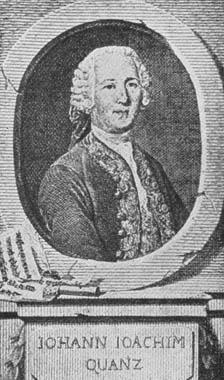
Warning: images may be copyrighted. If no copyright is shown, see their site of origin for details, or contact me.
Composition list
Chamber music
Instrumental music
Vocal music
Opera and lyrical music
Concertante music
Compositions sorted on opus (if available)
Op. 1
perdu
Qv. 2
Qv. 3/ 2-13
Sheet music for Johann Joachim Quantz

Arioso : Presto Sonata 333 (Organ) — Johann Joachim Quantz
organ — —
Composed by Johann Joachim Quantz (1697-1773) and Johann Joachim Quantz (1697-1773). Edited by Clarence Dickinson and Clarence Dickinson. This edition: pamphlet. Published by Library Commerce (LC.39087012339042PRESTO).
Price: $6.00

Arioso : Sonata 333 (Organ) — Johann Joachim Quantz
organ — —
Composed by Johann Joachim Quantz (1697-1773) and Johann Joachim Quantz (1697-1773). Edited by Clarence Dickinson and Clarence Dickinson. This edition: pamphlet. Published by Library Commerce (LC.39087012339042ARIOSO).
Price: $5.00

Quantz, Johann Fl√∂tenkonzert in G major Trombone Solo Posaune Soli St√ºck St√ºcke Piece Pieces Tromb√≥n harsona Trombonas Tromb√≥ trombon Pozoun — Johann Joachim Quantz
Trombone — Solo Part — Classical Period
Composed by Johann Joachim Quantz (1697-1773). Arranged by wenner. Classical Period. Solo Part. 2 pages. Published by christoph (S0.740185).
Price: $1.00

Mozart - Flute Concerto No. 2 in D Major, K. 314; Quantz - Flute Concerto in G Major — Johann Joachim Quantz
Flute — Softcover Audio Online — Classical
Music Minus One Flute. Composed by Johann Joachim Quantz (1697-1773) and Wolfgang Amadeus Mozart (1756-1791). Sheet music with CD. Music Minus One. Classical. Softcover Audio Online. 32 pages. Music Minus One #MMO3362. Published by Music Minus One (HL.400057).
Price: $19.00

Quantz Trio Sonata in G Minor for Flute, Violin and Continuo, QV 2:34 — Johann Joachim Quantz (1697-1773)
Flute,Bassoon,Violin,Cello — Score,Set of Parts — Classical Period,Baroque Period
Composed by Johann Joachim Quantz (1697-1773). Classical Period, Baroque Period. Score, Set of Parts. 40 pages. Published by Joseph L. Wilson, Jr. (S0.282971).
Price: $5.00

Quantz Concerto in G for flute — Johann Joachim Quantz
Piano,Flute — Piano Reduction,Set of Parts — Baroque Period,Repertoire,General Instructional,Recital
Composed by Johann Joachim Quantz (1697-1773). Baroque Period, Repertoire, General Instructional, Recital. Piano Reduction, Set of Parts. 32 pages. Published by Editions Glenn Michael, Caracas, Venezuela (S0.97503).
Price: $3.00

Flotenkonzert in F — Johann Joachim Quantz
Flute solo, 2 Violins, Viola, Cello/Contrabass, Harpsichord — Single Part, Flute —
Composed by Johann Joachim Quantz (1697-1773). Edited by Horst Augsbach. German title: Quantz: Concerto In F Qv 5:149. Single Part, Flute. Composed 1804. QV 5:149. 8 pages. Duration 16 minutes. Carus Verlag #CV 17.011/21. Published by Carus Verlag (CA.1701121).
Price: $6.00

Flotenkonzert in F — Johann Joachim Quantz
Flute solo, 2 Violins, Viola, Cello/Contrabass, Harpsichord — Full score —
Composed by Johann Joachim Quantz (1697-1773). Edited by Horst Augsbach. This edition: Paperbound. German title: Quantz: Concerto In F Qv 5:149. Full score. QV 5:149. 44 pages. Duration 16 minutes. Carus Verlag #CV 17.011/00. Published by Carus Verlag (CA.1701100).
Price: $31.00

Flotenkonzert in F — Johann Joachim Quantz
Flute solo, 2 Violins, Viola, Cello/Contrabass, Harpsichord — Single Part, Viola —
Composed by Johann Joachim Quantz (1697-1773). Edited by Horst Augsbach. German title: Quantz: Concerto In F Qv 5:149. Single Part, Viola. QV 5:149. 8 pages. Duration 16 minutes. Carus Verlag #CV 17.011/13. Published by Carus Verlag (CA.1701113).
Price: $6.00

Flotenkonzert in F — Johann Joachim Quantz
Flute solo, 2 Violins, Viola, Cello/Contrabass, Harpsichord — Single Part, Violin 1 —
Composed by Johann Joachim Quantz (1697-1773). Edited by Horst Augsbach. German title: Quantz: Concerto In F Qv 5:149. Single Part, Violin 1. QV 5:149. 12 pages. Duration 16 minutes. Carus Verlag #CV 17.011/11. Published by Carus Verlag (CA.1701111).
Price: $6.00
(Contributed by Adam Mansbridge <ifbur@worldchat.com>.)
German flutist and teacher of Frederick the Great; Quantz began playing the double bass at village festivals at the age of eight and in his childhood learned to play several other instruments. From 1714 he was assistant city musician, first in Radeburg, then in Pirna. From 1716-18 a member of the town orchestra in Dresden under Heine, utilizing a leave of absence in 1717 to study counterpiont with Zelenka in Vienna. In 1718 he became a oboist for the king of Poland’s orchestra stationed alternatly in Dresden and Warsaw, soon becoming a flutist after studying with Buffardin. In 1724 he studied counterpiont with Gasparini in Rome along with the Saxon ambassador Count Lagnasco. Went to Paris and London for 10 months then back to Dresden. In 1728 he so pleased crown prince Frederick with his playing that he was made Frederick’s personal teacher. In 1741, after Frederick became King of Prussia, Johann Joachim entered his service in Berlin and Potsdam for the rest of his life as chamber-musician, court composer and director of palace concerts on a substantial salary. He added a second key to the flute and invented the sliding tuning device.
Quantz composed 300 flute concertos and 200 other compositions for flute, solos, duets, trios, quartets, etc. Published: six solo sonatas for flute with bass, six flute duets, five sonatas for two flutes, hymn settings for 22 of Gallert’s poems. He also published a Versuch einer anweisung, die Flote traversiere zu spielen (four editions, 1752–1906, also in French, Dutch and English translations) It was a comprehensive treatise on the music of the time besides being a flute method.
Comments
Anonymous (not verified)
Sun, 2011-05-15 15:20
Permalink
de genoemde link 'multimania'
de genoemde link 'multimania' is niet bruikbaar. Beter is www.jjQuantz.org of www.Quantz.info
Groet, Ed T